Blue light
What happens when you change direction?

I’m trying to get outside. I’m trying to get out into the daylight which is becoming a deeper blue. Nothing is stopping me except warmth and my own inertia. I want to get outside to run, to get back to the rhythm of running which I’ve lost, but I can’t seem to find my way back. I’ve left it too late in the day, I think. It’s mid-afternoon and still light, but the arc towards dusk has started and soon its pace will accelerate. I know that this is an excuse and I promise myself that I’ll go tomorrow. Today I’ll walk - it’s a start, of sorts.
I walk up to the park where I run. It’s a narrow slip of land, squeezed between railway lines and the backs of terraced houses. The path around the park is a stretched-out figure-of-eight, long and slim around a burn, before crossing over to circle a loch. The loch is a flooded pit, once a source of clay for Portobello bricks which were fired in bottle kilns down by the sea. When it rains, the park reverts to its silty self; surface water sits in puddles and drowns the grass. As the loch floods and frays, the shrubs on the bank stand half-submerged and helpless. The ragged edges of the loch become shallows, cloudy with stirred up sediment, like the colloid of an unresolved argument.
When I’m running, and the running feels good, the figure-of-eight path is an infinity loop. It contains my thoughts. I disappear inside myself, aware only of my breath, my muscles, my stride. I run the loop in the same direction mostly, and the familiar bends and straights and intersections help me float. When I refocus, sometimes I find I’ve lost my bearings and I can’t work which part of the park I’m in, which segment of the loop, or how long I’ve been running.
Occasionally, I run the figure-of-eight in reverse and I’m surprised at just how different the park looks. But then, I’ve often walked through woods and found myself unsure of my route back, even though all I’m doing is retracing my steps. The reverse view is familiar but different, like a side step, a mathematical translation. It’s like carbon paper used to copy a letter; you peel it back to reveal the transfer of dark pigment to white cartridge and the translucent, used-up traces of writing. A residual, negative twin of the original; identical but inverted.
As the daylight fades, I’m walking in reverse. And I’m looking for residues and negatives and inversions.
South, above the trees, grey flakes rise from an incandescent snow cloud. Sleet blows like wood ash into cracks in the tarmac path. On the loch’s small island, gleaming orange twigs of young crack willow look as if they’re on fire.
Here, in early January, daylight is scarce. It’s 56 degrees north and, today, it’s fully light for just over seven hours. At dusk, the horizon is brightest towards the south west as the sun takes an astronomical short-cut, its mid-winter arc so much lower in the sky. This is how I see it, but the sun would disagree. It’s the earth’s tilt that has changed, not it. The short-cut is not of its making.
Daylight is blue light. Although all the colours of visible light travel from the sun, blue light collides with molecules in the atmosphere like high energy pinballs, scattering towards our eyes. I read that mid-winter clouds are sometimes pink because snow absorbs the wavelengths of blue light and it’s true that I can see pink in the fringes of this sky. The natural blue waves of sunlight help us wake and sleep; they’re good for our bodies and for our souls. This year, public libraries in Orkney have started to lend out daylight frequency lamps to people whose mood is affected by low light. In mid-winter, daylight can feel like a treasure.
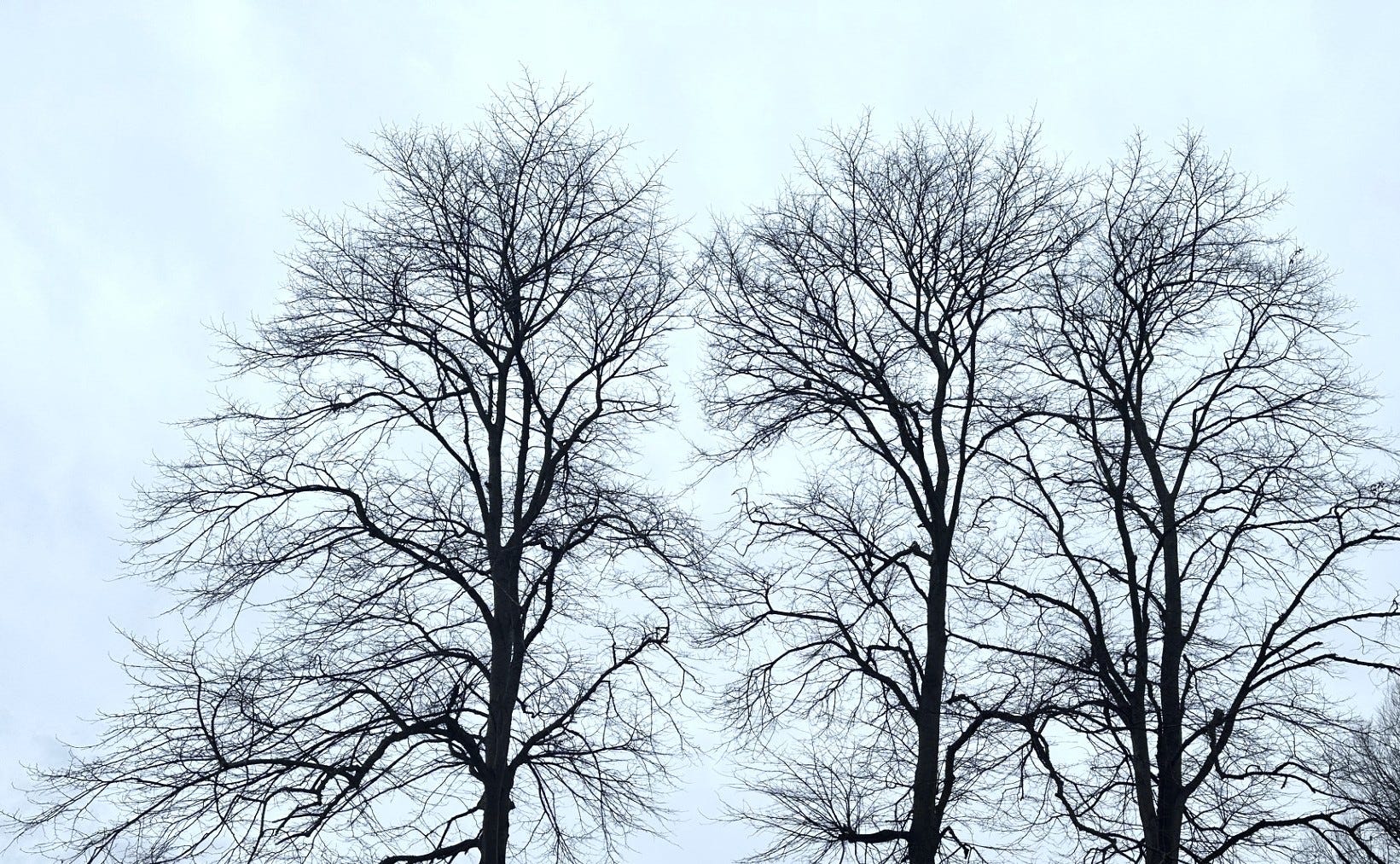
Image: Edi Longwave (2026) Birch trees in Figgate Park.
I look up into the branches of the trees. They’re becoming silhouettes, flattening, losing their volume. A few leftover leaves hang like scraps of burnt paper, dark and limp. The trees reveal themselves as they sleep, exposed. Young beeches send out tiny wriggly branches, like fancy lace cuffs. A lone sycamore raises its limbs, giving thanks perhaps. Acers make lightning zig-zags in the sky, as if they can’t decide which way to grow. Soft lengths of willow stems weep into the loch. From their branchy signatures, I begin to imagine their character.
It’s quiet now and only the calls of crows carry on the air. Without leaves to soften sounds, the park’s acoustics are sharper and more crystalline; caws echo across the bowl of space. I spot the crows, dispersed in high branches, and their nests nearby, dense and dark against the sky, Beside them are twiggy galls and snagged plastic bags. Something glittery and multi-coloured catches my eye. It’s the skin of a rainbow-shaped balloon; shiny, punctured and fluttering, trying to escape back into the clouds.
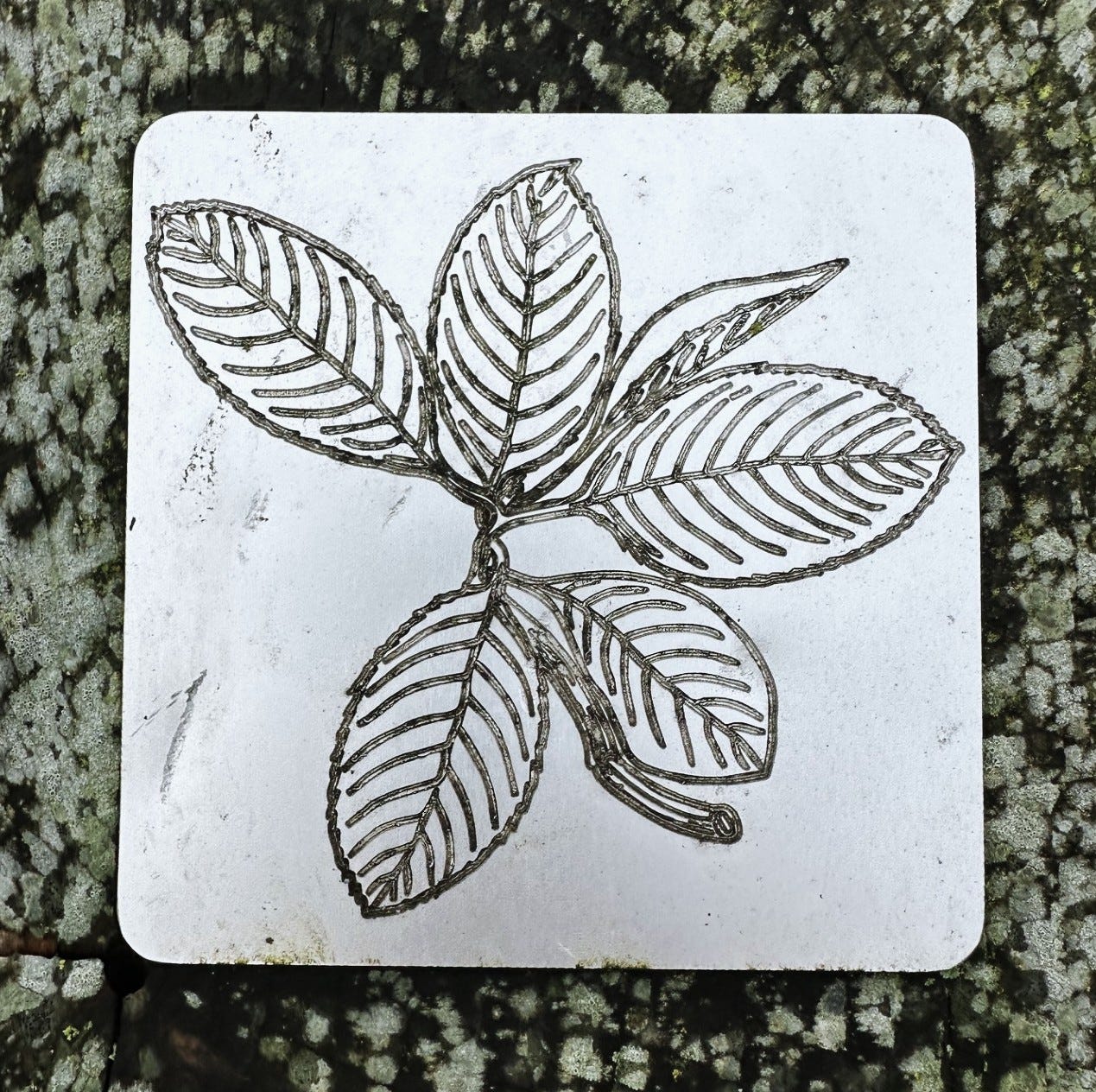
Image: Edi Longwave (2026) Figgate Park, Arbutus leaf etching on a metal plate.
Beside a few trees are small metal plates, mounted on short wooden posts. Each is etched with the simple outline of a leaf and the name of the tree on which the leaf grows. I find these etchings beautiful; they’re like a jeweller’s tribute to nature. But they’re there not to be admired – they’re there for making rubbings and I wish I’d brought some paper and pencils. As a pencil shifts back and forth over paper, a leaf emerges in outline and in a negative form. It’s identical to the image on the plate, but inverted.
Back home, I mess about with some photos I’ve taken of the trees in the park, inverting their tones so that their silhouettes turn light against a dark sky. Oaks resemble stripped back arteries. Birches look like bronchioles. They’re lungs, rivers, capillaries; they look like the parts of our bodies that carry fluid and sustain life. Trees may be rooted and silent, but it’s so obvious from these playful manipulations that we share a form and structure. It’s serious. They are our lungs in reverse; we breathe in what they exhale and they receive our breath.
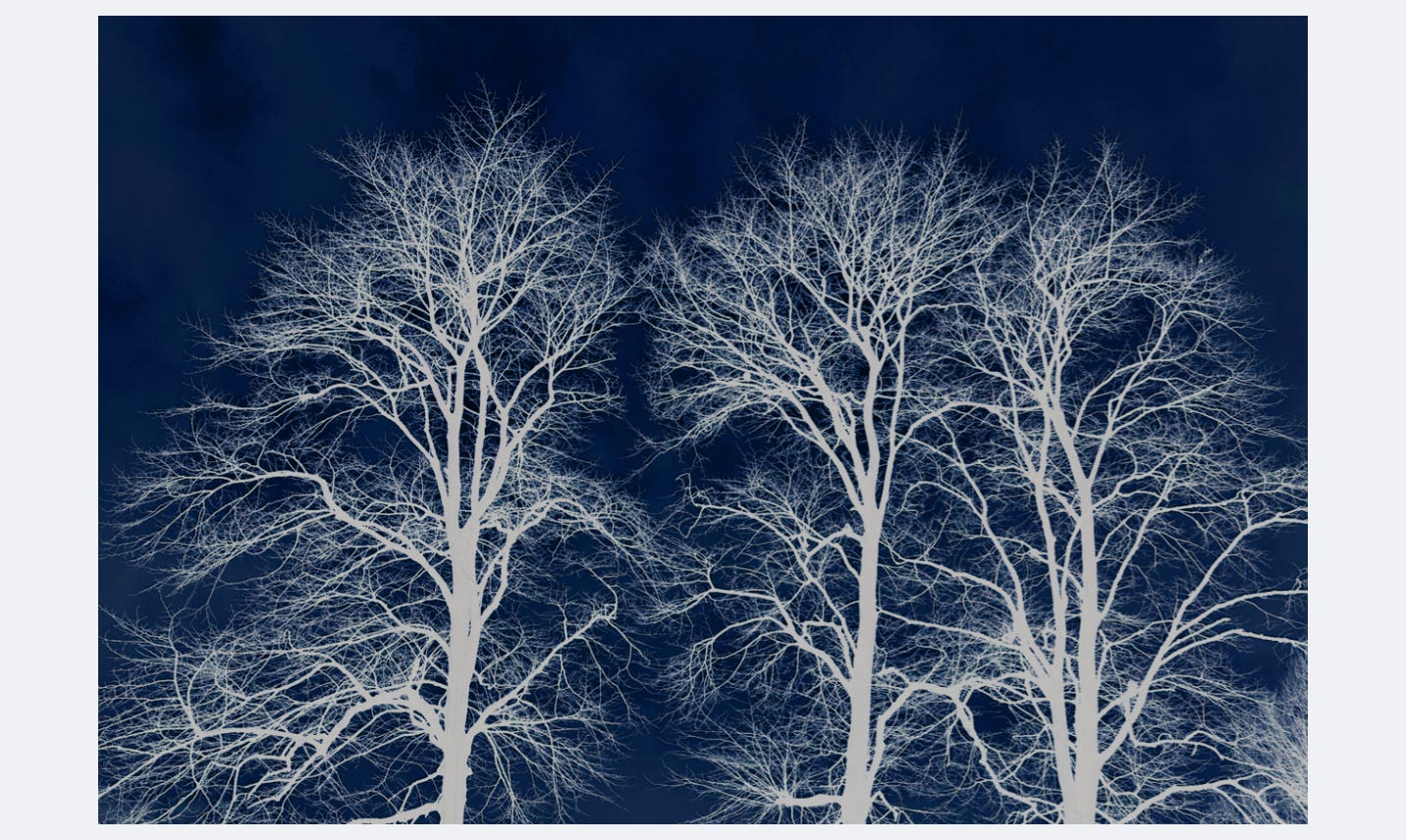
Image: Edi Longwave (2026) Figgate Park, digitally altered photo using simple editing software.
These inside-out images make me think of x-rays, which used to need backlighting to be seen. I remember once walking in the city one winter night past the old Royal Infirmary, its windows blazing. Framed against the glass was a chest x-ray, illuminated by the fluorescent lights of the wards shining out into the darkness. By day, the window had been used as a convenient lightbox. By night, this abandoned x-ray was lit up for all to see. Private life became public spectacle as light and darkness inverted.
They make me think of cyanotypes too - prints made by soaking paper in a light-sensitive chemical and then exposing it to sunlight. An object placed on treated paper blocks the light that turns the chemical blue, leaving its exact trace in a pale negative form. It’s a simple form of print-making that was used to make early botanical images and it’s is still used by artists and others who love the delicate, ethereal after-images that result. It’s a lovely, tactile process and slow and watchful too, as the paper begins to change colour, turning a deep cobalt blue. The images are momentary and weather-dependent and they’re also indexical: life size and made through direct contact between the plant or leaf and the paper ground. Cyanotypes create a negative image of the plant, but these bright inverted forms make me see something so obvious that I’ve missed it. Plants and trees are made of light. They’re a form of captured daylight, just as we are too. Like us, they live with shortened, darker days, drawing in and slowing down, waiting for the earth’s tilt to shift.
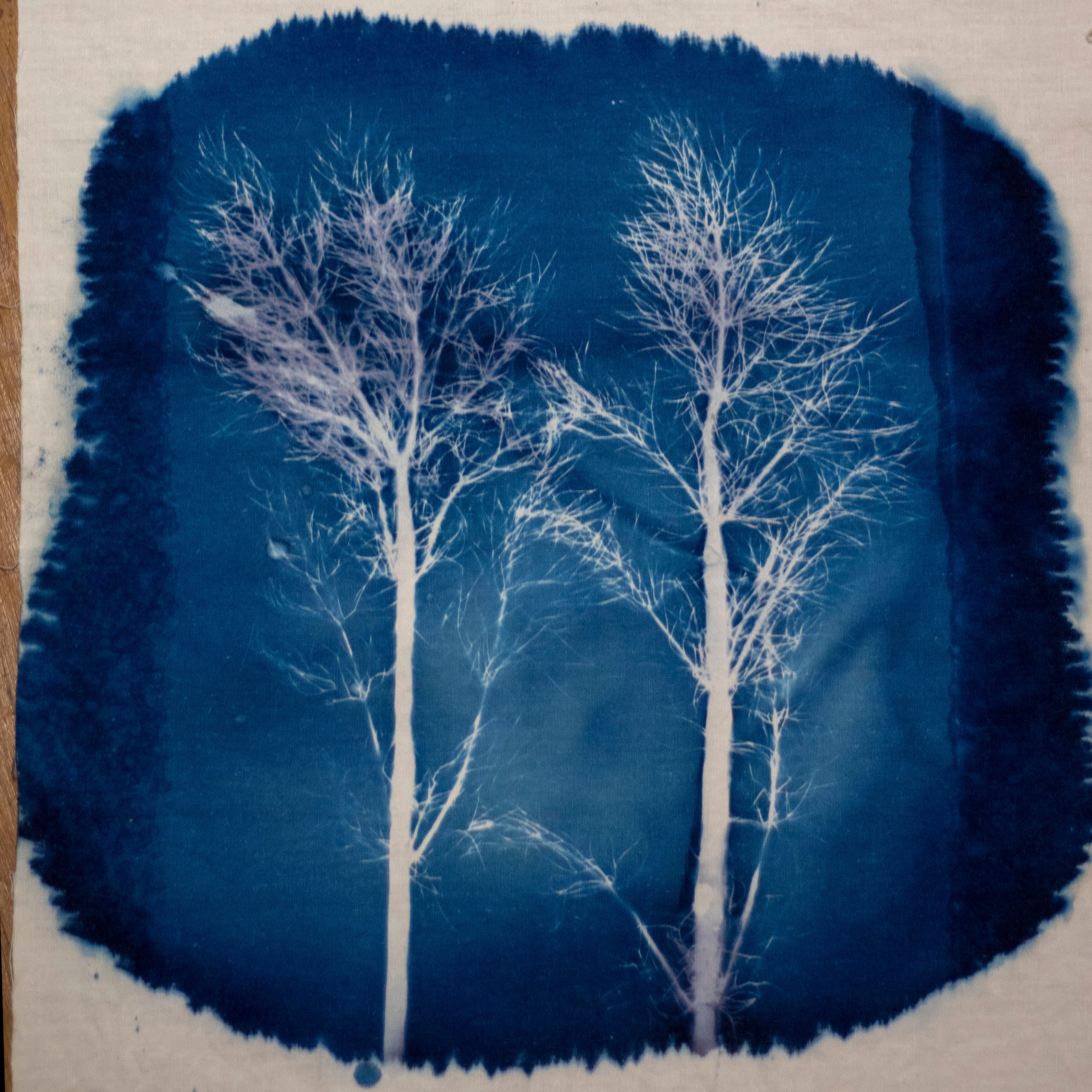
Image: Chiara Chiarel, Cyanotype. Two stems of fennel.
I finish the infinity loop. Dusk has fallen properly now and the park’s silhouettes and shadows are invisible; the leafless trees veil walking figures and a lone runner. A dog off its lead races and dodges through a stand of young birch, crunching through leaf fragments and sending them flying. It’s wearing a pulsing light on its collar so that it can be seen. Blue light flashes and deflects off branches, ricocheting between the reeds on the edge of the burn. The dog races down the bank and into the water, scattering sapphire droplets, before it’s back up the other side, bounding away. The pulsing blue light is gone, absorbed into winter darkness.
Please feel free to share my post with others you think might be interested.
Please do subscribe for free or leave a comment on this post. It would be great to know that you’re reading and enjoying my work.
Loved the blue tints in this!
Such a beautiful piece of writing. The connections you bring to the page show the world in a different way. Expose the joy and wonder we have all around us.