Marmalade season
Preserving time

The oranges sit in their nets on top of the washing machine. There are an awful lot of them. And, at their side, twice their quantity of sugar - bags and bags of it - what a weight. I’m not sure I have enough containers, or lids. I’ll need to check the cupboards. They glow against the machine top with luminous energy. I pick them up. They’re lumpy, near fluorescent - you could light a path with them. Or the dial of a clock.
Seville Bitter
Produce of Spain
Refrigerate for freshness
For cooking only
8 Jars.  Maybe.
I’ve made marmalade in late January for a decade now. It’s become a thing. But even though I know it’s nearly time to gather what I need – sugar, fruit, string and muslin - I’m slow to move. J buys the oranges and sugar. There’s a running joke that I’ve an artistic aversion to supermarkets and, though it’s true that I avoid them, it’s not for artistic reasons. J is a better shopper than me and enjoys it, or so it seems. Everything’s relative, I guess. Left to me, marmalade-making would remain an abstract thought and I’d miss the orange-shopping window which, according to J, is short. Better get them while we can.
It’s a team game. J chops and juices the oranges. I simmer them for hours ‘til they’re soft, sweetening and boiling them, and stirring, stirring, stirring. I test for a setting point, and then again, worrying that I’ve missed it in the time it takes the liquid to cool. Making marmalade should be done in a day, or possibly overnight. But sometimes work and, well, sloth get in the way and it stretches out. I soften the oranges and stir in the sugar, hoping this half-preserved mush won’t mind being left for a few days. Usually it doesn’t, but I did once forget it for a week, returning to a mild ferment. Perhaps it fizzed with irritation at my neglect, but it did taste very good.
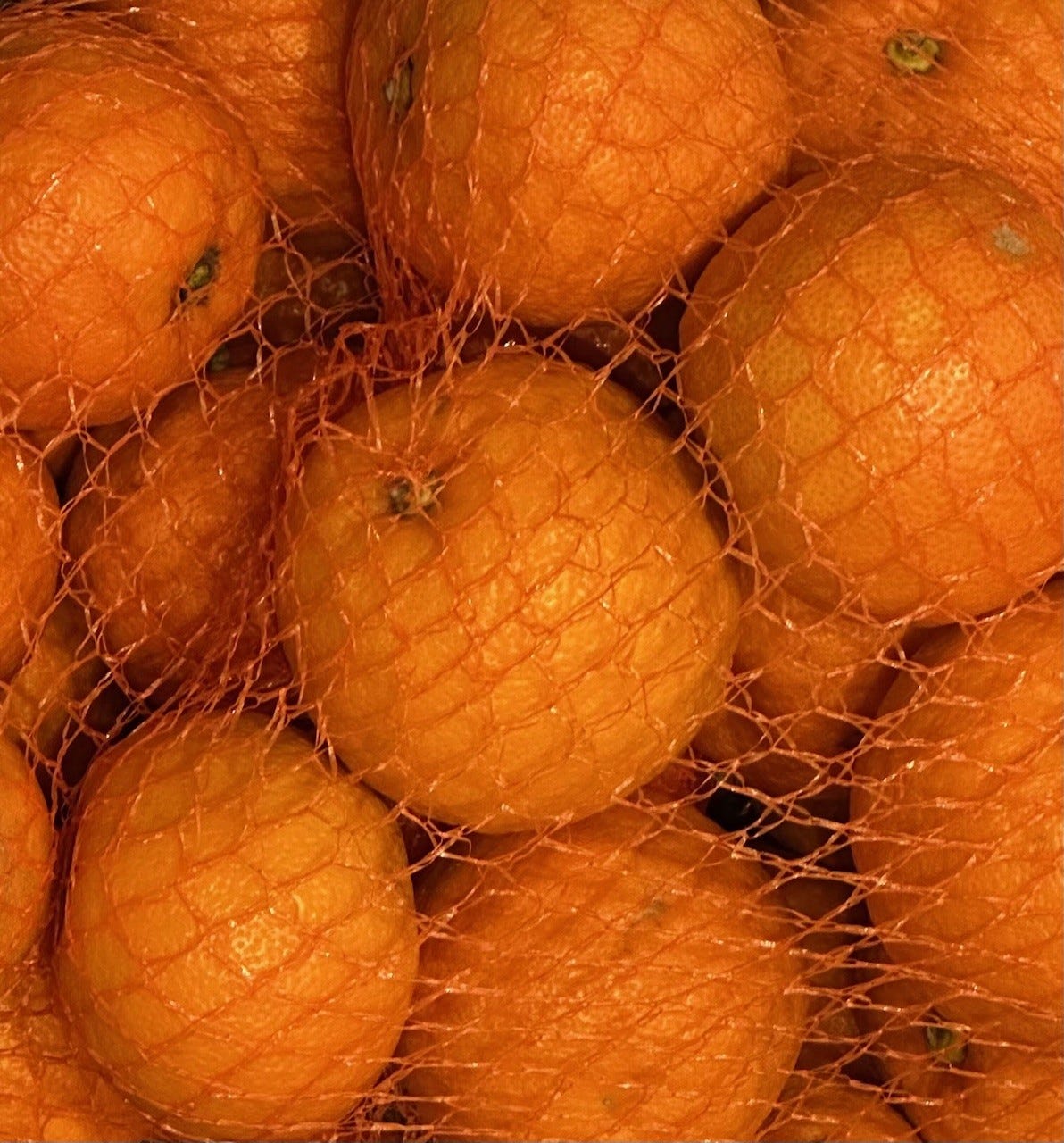
Image: Edi Longwave (2026) Kitchen table.
There’s a clear divide in my house between the marmalade-lovers and the leavers. Feelings are strong; it’s a marmalade chasm. My flame-haired daughter loves the stuff, slathering it thick on toast and hunting jars out of the eaves when she needs more. Her dark-haired sister and J can’t bear it, preferring honey and jam. I’m not sure whether hair colour is a predictor of your taste in preserves, but I have wondered.
I hold the net of oranges to my nose and sniff. They have a rasping, woody smell; a mix of cedar, bay and myrrh. With my eyes closed, I see peat pools, the toothy bark of a copper beech and translucent amber. The fruit has warmed up again after its long journey here, packed into containers with hundreds of thousands of other refrigerated oranges, picked early and cooled quickly. I wonder if they sense their distance from the trees on which they grew. Their scent is dry and diffident, a shadow of their interior selves. Like the after-scent of fabric in a box pulled from storage, a perfume almost evaporated but not quite. Breathing it in awakens memories - of a person, a place, a time that’s passed. But the scent eludes capture. Inhale again and its gone.
Marmalade gleams in my memory. Chill mornings in my grandparents’ house on a hillside near Aberdeen. Dressing as quickly as possible in clothes heated by the convector of a three-bar electric fire, warmed unevenly so that patches of my tights and vest singed my skin, but the sleeves felt like snowholes. Essential, but dangerous, there was always a chance they’d catch fire. Their bungalow had been built quickly after the war with a steel frame and no central heating. It was north-facing and icy to its core. We’d take refuge in the yellow kitchen, warm from the oven heating Aberdeen butteries – huge, warm, bergs of lard and salt and flour - heart attacks in waiting. With marmalade and a cup of tea, their salty and flaky chew was just right.
Marmalade insinuates itself. In Plasterfield, on the Isle of Lewis, my sister and I would be up at dawn, like young cats. But our other granny, my Dad’s mum, would have been up for hours before, waiting and setting a peat fire to warm us. She’d cut an orange into quarters to keep us busy as she made newspaper twists and crumbled firelighters. In Gaelic and some English, scratching for words, she’d ask me about school, my friends, and with a wink, whether I had a boyfriend, even though I was only seven. ‘Here you are, a ghràidh’. We watched her hands work, pushing the paper twists towards flames, then nudging them so that they’d catch the peat. I learnt from her how to set a fire and I still make kindling paper twists in the same way.
We saw her rarely. Back then, the journey north and ferry over the Minch took at least a day and sometimes more. For my Dad, there was little left on the island that he’d chosen to leave; nothing worth giving up so many days off work. Only much later did I realise how poor she was, in a post-war prefab on the edge of the edge, knitting to pay her bills and pass the time. How lonely she must have been too, widowed with three sons on the mainland, busy with their own lives. She’d waited months for us to arrive off the ferry and then hours for us to wake. How precious those orange quarters were to her - an exotic offering of love and no translation needed.
My Dad taught me to make marmalade. He also taught me to use a sewing machine. I’m proud of him for knowing these things – I think they’re unusual for a man of his generation. He’s a gentle, practical man who defers too often to others and holds back his own opinions, but on marmalade he does have views. Shop-bought jars are too sweet and jelly-like, too finely-cut. The darker and sharper the better, with great chunks of zesty peel. He’d get bored of sieving the residue after juicing the fruits so he’d boil the oranges whole - skin and flesh and all. I got used to the soft crunch of cooked pips and lumps of skin, creating ultra-bitter bursts that made my mouth pucker. Actually, it’s this that I loved most about his marmalade - it spoke of who he really was. Deprecating but particular. Himself expressed as an uncompromising, tear-inducing, throat-catching preserve. He knew his own tastes well, but only those who ate it would get to know them too.
He doesn’t make marmalade now. He stopped as I began to make mine and shared it with him. It takes effort and, slowly, illness is robbing him of strength. Even if he wanted to, it wouldn’t be safe to stand and stir a boiling pot.
Time moves in circles, but its revolution is uneven. To me, January is like trying to move a bicycle when its pedals are stuck top and bottom. It resists my desire for light and colour, staying stubbornly monochrome. Right now, the days lengthen slowly, but soon the pace of change will accelerate. Today, that’s hard to imagine.
Marmalade is an anchor point in the circle of the year. It throws into relief the other shapes that time can take. My daughters are teenagers now, my older girl is nearly finished high school. For years, we’ve been churning and furrowing through school terms, knowing that there will be another. We’ve run the algorithm of school: clothes-buying, clothes washing, shoe-polishing (sometimes) homework (not always). Not thinking about it much, just getting on with it and trying to keep going until the holidays. Time passed evenly it seemed, but now it’s flying. We’re like the planets closest to the sun, turning our fiery gaze to outer space, looking for a kinder trajectory. Late teenagers orbit fast - I guess it’s to reach escape velocity. I’ve been dreading this.
Since last January, my Dad has become much less stable – it’s been a rapid deterioration after years of slow change. In the summer, I bought him some hiking poles to help him walk small distances. Until then, he’d refused help and accepted them only because they were for sport. I understood his pride – I would have done the same. But now, to keep safe, he needs a handrail on his staircase and another on the outdoor steps. I’m terrified he’ll fall. This isn’t a steady orbit, it’s an unpredictable loop back as he loses the mobility that he helped my teenagers, as toddlers, gain not long ago. Seven years ago, during marmalade season, he was sledging with them, taking powdery bankings at speed.
And so, this is my season of seasons. Time to make marmalade. Bittersweet feelings not spoken, but spooned out. Love letters in solid form. I share it with friends whom I’ve discovered like it as much as I do, and post it to those further away. And I make it for those enclosed in my own loop of time. For my grandmothers, now long gone, for my Dad and for my flame-haired daughter as she fledges. One day she might even help me stir and set it. And I know I’ll do it all again next year, anchoring time once more.
Marmalade — my favorite jam experience! Why? Maybe it’s the color. Maybe it’s the fresh tart-sweet burst that’s just like life. Maybe it’s because it reminds me of orange blossoms—such a swoon-worthy scent! Thank you!
Oh my gosh. There are so many beautiful passages in this. It made the laugh and cry. Your way with words and using them is exceptional. I love reading your essays.