Night vision
Storytelling in a city at dusk

We’re tracing a route round the city. The Crags turn a ragged, slanting pink as daylight seeps out of the Cowgate. The tenements are high here, eight storeys in places and light-stealing. They’re crusty with carbon from old coal fires. Moss clings to the undersides of the bridges that span the street and they drip like winter noses. A valley scraped out by ice, the Cowgate has never warmed up. Even in daylight, it’s Edinburgh’s underbelly; an ink-dark thoroughfare with a character to match.
Julia and I are taking her students on a field trip next week. Today, we’re scouting the route, in search of talking points and hazards. I teach art and Julia is a scientist. We don’t know each other well, but there’s an affinity; we’re both geographers and our teenagers are the same age and stage. As we walk, we talk, making connections and sharing fragments of our lives.
We want the students to tell stories of the city through nature. We want them to notice the stones and plants and seeds under their feet and above their gaze. We could do with more daylight though, and I’m not sure how much we’ll see. But twilight will have to do and we climb up towards High School Yards as the city’s streetlights blink into life.
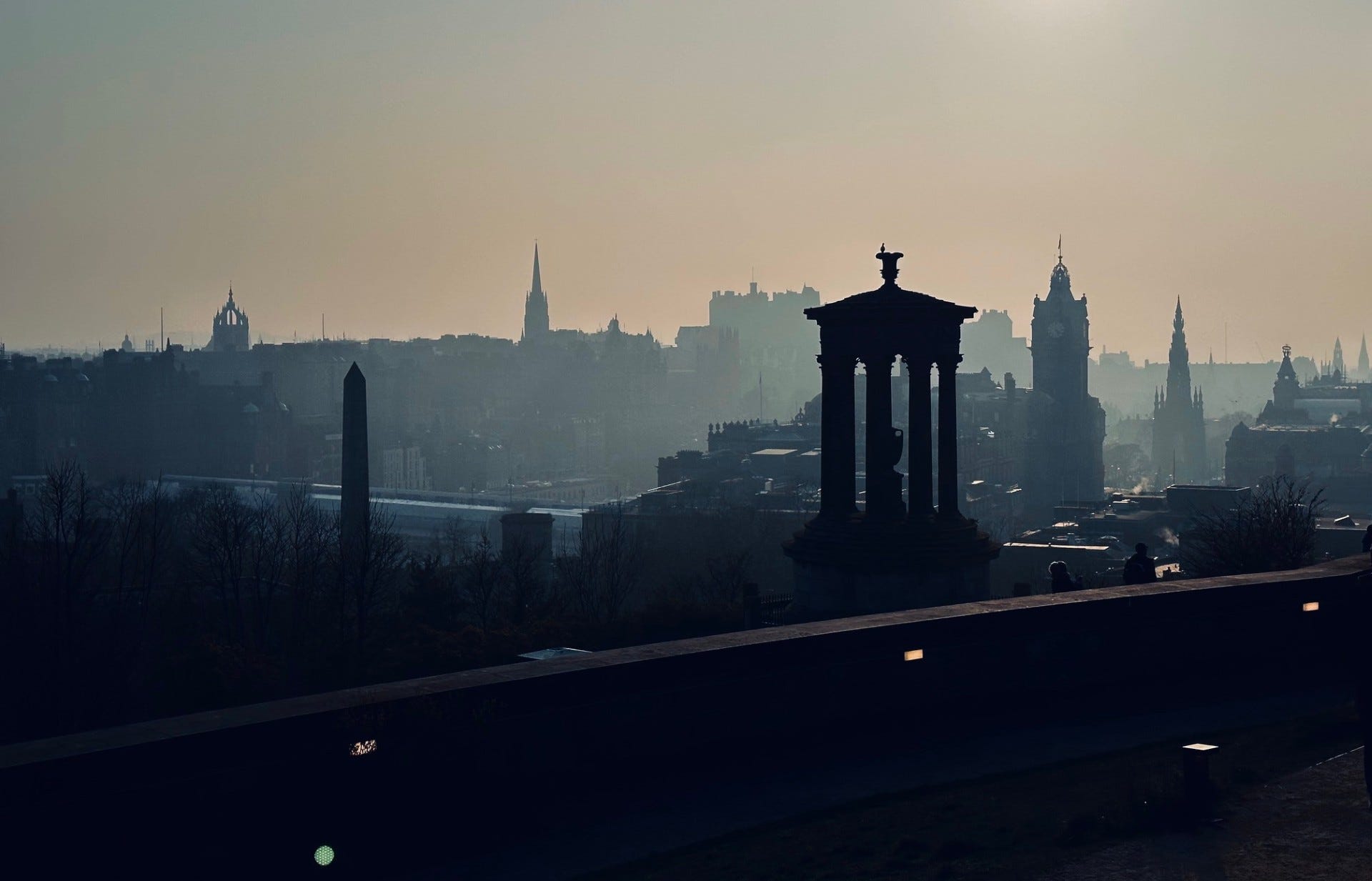
Photo: Edi Longwave (2026) Looking south west from Calton Hill over Edinburgh’s Old Town
We’re standing between two ash trees, nearly full-grown it seems. The woodchipped path is starting to decompose and there’s a scent of earth. Julia looks up at the branches, noticing that they’re growing strongly in two opposing directions. She disappears behind one tree, examining it and patting its bark. “I think that’s south”, she says, pointing over the buildings. “Look at the ridges on the trunk – they’re much wider and deeper at the front than at the back. That’s the tree responding to sunlight and growing well”. Sodium light falls on the tree’s bark, throwing it into strong orange relief – the ridges look like tiger stripes. I’ve been here many times before but I’ve never noticed this. I put my hand on the bark and stroke it. Its trunk arches forward like a belly, gently swollen by sunlight and sugars; the ribs on its bark furrow like stretch marks. I slide my arms round its girth and give its teenage trunk a hug.
Although it’s well past dusk, it’s early still and the lights are bright in the old school annex. Converted into offices now, plants crowd and clamour on the window sill. A Chlorophytum weaves its narrow leaves between two bobbing Calatheas. Pilea jostle in a froth of green bubbles – ever the optimists. The glass panes are misty with transpiration – leafy conversations condensed from fluorescent light. “When I see a plant in the city”, says Julia, “I can’t help noticing others”.
Up round the back of the Museum, we head for the old Royal Infirmary. Two decades ago, the hospital outgrew its site and shifted to the city’s southern edge. Its Victorian carcass has been reworked and renamed Quartermile. Gentrified, it’s still concerned with futures, but tech ones now. By day, workers look out on the city through huge tinted windows but, at night, strip lights blare over empty desks and screens and chairs. There’s a large Yucca on each floor, as upright and solitary as a sentinel. A design afterthought? Corporate values performed by a houseplant? The darkness lights up our thoughts. We see the Yuccas in their huge glass frames but, silent and separated by floors and ceilings, they know nothing of each other. For a while, we stand and look at them. We are as forlorn as they seem. We can’t do anything but acknowledge them and it looks as if they could do with some company.
We mistake our route and double back, turning into the Vennel, all cobbles and steps. It skirts the Flodden Wall - Edinburgh’s ancient boundary - visible only in fragments now, dispersed across the city. Often, I use it a short cut, rushing south, usually hurrying; thinking rather than looking. But tonight, we’re heading north and we’ve slowed right down. There’s an old street lamp which casts sidelong light, amplifying the pock-marks and bands in the sandstone wall. I run my hand along them, thinking about Carboniferous beaches, ground down by seas from another age, timescales that I’ll never grasp. Compressed and attenuated, sand grains became strata. The wall is made of great chunks of sandstone, levered and heaved from quarries nearby, and something harder too, igneous blocks, whinstone maybe. Above our heads though, the wall looks like honeycomb – concave pits filled with shadow. It’s begun to spall; 500 years of biting westerlies carrying rain, smoke and salt have eroded the sandstone faster than its mortar. I reach up into a hollow. The rock crumbles between my fingers and ancient sand, loosened, blows back onto the street.
The setts run transverse like weft. Under the weak lamplight, they’re a fluid, rippled surface, like sea in light breeze. Feet and hooves, cartwheels and tyres have compacted them, smudging and nudging their lines into waves. Invisible by day, lamp light reveals a time-worn skin. The city shows its wrinkles slant-wise.
We take the stairs down, each step consumed at its front edge, tilting us forward. We’re looking for plants that have rooted in the Vennel’s stone surfaces and we don’t have long to wait. Buddleia has sprouted through the mortar of a wall and wound itself around a water pipe. It’s been there for years, it seems, and it’s become gnarly. Another pipe has been installed on top of the plant and it’s knotting itself around that one too. Wrangling around each other, there’s an air of mutual support. The yellow glow from the windows opposite drains the plant and pipes of colour and it’s difficult to tell wood and metal apart. They’re monochrome and intertwined - a viney, venous cyborg.
One last stop now. It’s getting late. We walk down The Mound and peer over the railings at a line of trees which grow on a steep banking. Their black branches reach up as if they’re trying to grasp the chill air, and tiny cubes of shop light filter through them. Below, a public park lies on what was once the Nor’loch, the mediaeval city’s cesspit. It was drained and cleared centuries ago but, under the flowerbeds and paths of Princes Street Gardens, are residues of other lives.
It’s a gothic beauty, Edinburgh. There’s easy romance to be had amongst its spires and strata, its closes and well-worn steps. It reeks of stories, real and imagined, and more often than not, they’ve a harsh edge. We’re standing below the Old Town, with its cramped tenements built close to the Castle, and the Flesh and Lawnmarkets which fed its people. Fleshmarket Close is an odd shape. It’s unusually straight and cuts through the curve of Cockburn Street like a butcher’s knife. Or a chute. I mention that to Julia and she gives a half-smile; l I think can see what’s on her mind and our mood changes as we look back at the trees. Now, their silhouettes are like blood vessels - lungs and hearts, veins and arteries. It’s an ink-black thought and a melancholy one, but it’s another story of this city; of how it ate and lived, how this once bloody, decomposing dump helped it thrive and grow and change. Sometimes the stories that this city tells – through its plants and seed and stones - emerge most clearly in darkness.
Edi, your evocative words allowed me to see (and feel!) a multilayered city I’ve never visited. I wonder how the students will experience this walk - perhaps you’ll let us know?
There’s so much life and character in the plants you describe, and such a feeling of age and darkness in the city. I feel the dirt and the strain of the people who once lived and worked there.