Spalling
Stories of stones and weathering

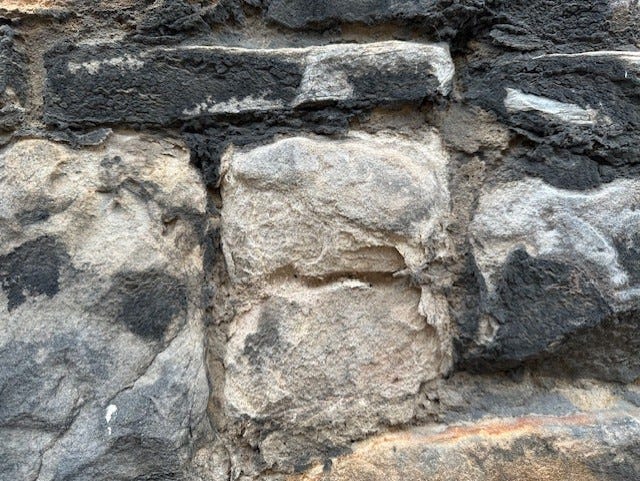
Photo: Edi Longwave (2026) Drummond Street, Edinburgh
The old Boiler House wall is grimy. Smoke and dust have left particulate shadows and years of salt rain have picked away at its stones. Scoops of bright ochre, here and there, concave and eroded, reveal fresh rock. As I run my fingertips over the block, it gives way. A stream of quartz and feldspar trickles to the ground, blowing into cobbled gaps. Sandstone chips are scattered below, like failed fledglings; the stones seem to be shedding themselves.
On a grey morning last week, I walked through the city to a lecture. Across the Southside and into George Square, people moved quickly ahead of me, crossing paths, taking corners at pace. As I fell into line and followed their rhythm, something happened. There was a shift of sorts, a crack. For an instant, I felt the air cleave around me. I’m twenty-two again, late for a lecture and walking fast, trying to find my place, trying to fit in. I’m in the same place, but then. Decades collapsed together and – as plane rubbed against plane - I felt a friction build. But the fissure closed as quickly as it had opened and, for a moment, I stood there, stranded. In the grey January air, as I tried to unfold myself, I shed specks from my edges.
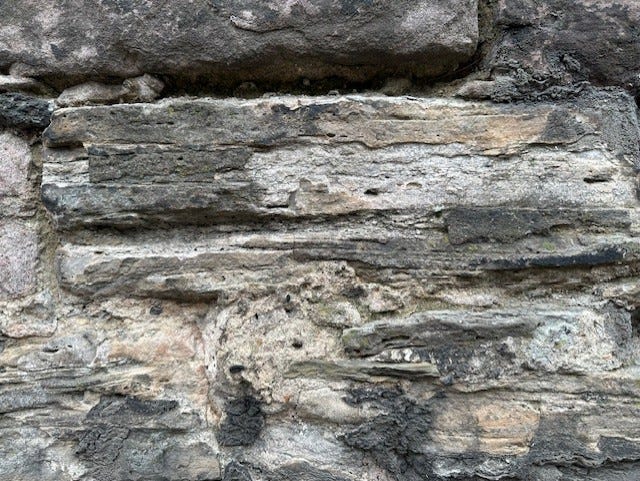
The sandstones in the old city wall have fractured. The mortar that holds them should wick away the winter rain, but it doesn’t now. Damp seeps around the edges of the blocks, between their particles, freezing and thawing them until they hold together no longer. They’re spalling – eroding and weathering and losing their form. The stones have been placed for their shape and size and some pieces lie cross-grain, their skeletons exposed in steps and strata. They erode unevenly, like wrinkles on gaunt cheekbones. Others are upended, displaying only their top bed. They spall plane by plane, their contoured depressions resembling dunes eroding.
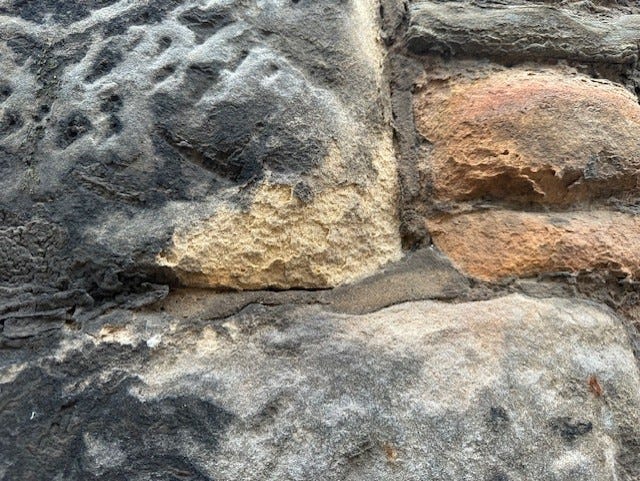
Photo: Edi Longwave (2026) Drummond Street, Edinburgh
Yesterday, at lunch time, I went up to the gym. It’s used by students, and some staff and locals too. I’m not always the oldest person there, but often I am. There aren’t changing rooms, so dressing and undressing is communal, discreet, eyes down and fast. It hasn’t ever bothered me but, today, half-dressed, I turned round. A young woman was watching me, exploring my back and my legs with her eyes. It was momentary, but I caught her curiosity and a look that I couldn’t place, before she turned away. I wonder what she thought she saw. You never notice your own body weathering, but suddenly I sensed a scattering, a loss of surface and form.
It’s only this past week that I’ve noticed the stones weathering silently. I don’t think it’s just me – nobody really pays them attention. They’re fragments of a structure which has outlived its usefulness. Crumbling – so what? I didn’t know how to describe the weathering stones or, even, think that there was a name for it, this spalling. And, now, I’m seeing it everywhere – on the corners of buildings, in boundary walls and at the foot of pillars where sandstone wafers are slicing off. It’s curious that I’ve started noticing it at this moment.
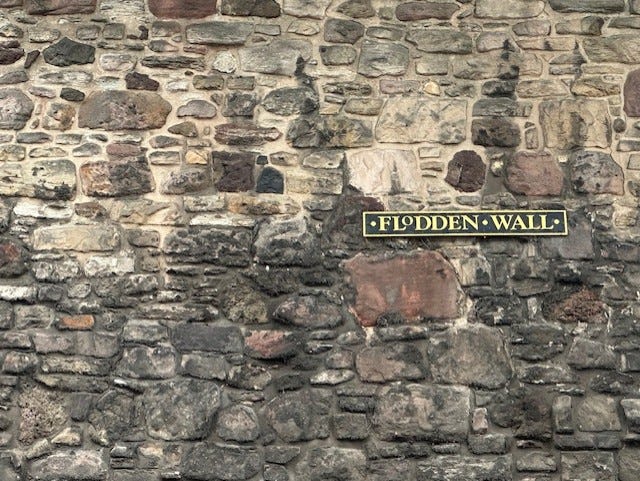
Photo: Edi Longwave (2026) Drummond Street, Edinburgh
I’m now late for the lecture but I need to see that I’m in one piece, holding together. The mirrors are ceiling-high above long troughs and blinding white light. The sinks and mirrors are laid out galley-style so that chrome-plated reflections volley and return infinitely. Glass panes and acrylic surfaces multiply and shimmer. It’s startling and confusing and I can’t get my bearings.
Somewhere, out of sight, I can hear ABBA on speaker phone. Dancing Queen.
In the centre of the room, two women are cleaning sinks. In navy uniforms with rubber gloves, they’re round-bodied and there’s age in their soft faces. They’re talking to each other, about their families, their health and their tea-break. I say hello and joke that I’d rather stay here than go into my class. Their music is loud and they don’t hear me, but they smile.
I wonder if sandstone remembers water, whether its grains recall being washed by other seas, in other times and places? Is this why moisture finds sandstone’s cracks with ease, just as memory breached my porous surface earlier? Sandstone seems to accept its disintegration quietly, with grace. Shifting and scattering into slivers, dispersing on draughts, its grains roll into crevices. It doesn’t seem to mind. Perhaps it knows that this is not really the end, that spalling is just a moment between past and future; an inevitable part of circling deep time.
I’m unsteady. I can’t shake the time shift in which I collided with an earlier self. Hot water explodes from the tap that I’ve turned on too far, clattering and fizzing. I recoil, bumping a hand drier with my shoulder so that it hisses hot air like a wasp’s nest. My makeup bag crumples and spills, plastic things bouncing off hard edges, sliding into the sinks, nothing to absorb their skittish energy. And ABBA are still singing.
She comes over to help me pick things up. She’s got a purple scar on her forearm, which doesn’t look recent. “The main thing is that you’re OK”, she says. I comb my fingers through my hair to straighten it, tugging a bit too hard.
“…having the time of your life...”
“Are you alright, hen?” I’m not alright and I know she can see it. She comes over and hugs me.
“Are you here to give a lecture or to go to a lecture?” I tell her that I’m a student today. That I’m going to a class about time and its meanings.
“Aww”, she says, “it’s hard getting older, isn’t it?” And that’s when I lose it completely.
She talks gently. I tell her I heard her talking to her friend about their families and how I worry about mine too. She smiles. Teenage kids and ailing parents. We’re both caught in the middle, between pasts and futures. Other lives refracting off our own as we splinter. As she hugs me again, I see slices of our backs and our fronts in the mirrors, receding and shimmering, on and on and on.
“Just you go in to your class now”, she says. “And, remember, you’re still twenty-two on the inside”.
Rocks become sand become strata, held together by rainwater’s leavings. Exposed and weathered they dissolve and fracture again, blowing into another time and space. Ancient sand becomes rock once more.
Particles coat and coarsen our skins, making us grimy with experience. But we weather too; we shed grains from within. As I walk, specks of feeling and incident and memory trickle into the seams of the city. They silt in cracks; they sediment and they leave traces.
I reach up to the flaking blocks again and feel the sand run between my fingers. We’re both carboniferous and caught in the circle of time. It’s ok. I put my hand on the stone and hold it there. We spall together.
Thank you for this beautiful piece. I find myself increasingly haunted as I walk through streets I know. I walk past a shop and suddenly encounter myself with my children when they were small and how absorbed I was in that moment in time and for a moment I'm there again. I feel then the spalling.
Often when walking my dog he stops to sniff. I think about his ability to smell the past. When he stops I stop to let him enjoy the social activity of the dogs who share his patch. The marking spot is the old stone boundary wall, he sniffs deeply, as if drinking in the odours. Every morning his stops give me time to reach out and touch the traces of what I now know is spalling. Thank you my friend.